Sudoku
Free Sudoku with a new daily puzzle and four levels from Easy to Expert. Every puzzle has exactly one solution.
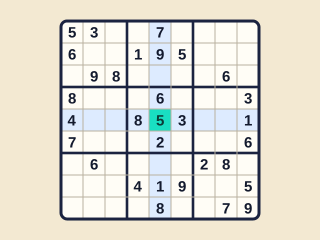
Sudoku
Fill the grid so every row, column and 3×3 box contains 1 to 9 once. Use notes for candidates and the hint button when you are stuck.
Try another gamePaused
The clock and scoring are stopped.
Sudoku at a glance
Guide updated
Sudoku is a logic puzzle played on a 9×9 grid divided into nine 3×3 boxes. The goal is to fill every empty cell with a number from 1 to 9 so that each row, each column and each box contains every number exactly once. No arithmetic is needed, only reasoning.
- Type
- Logic number puzzle
- Players
- 1
- How long
- About 5 minutes on Easy to 30 minutes or more on Expert
- Skills
- Logical deduction, concentration, pattern spotting
- Daily puzzle
- Yes, the same for everyone each day
- Controls
- Keyboard, mouse or touch
- Works on
- Phones, tablets and computers in a web browser
- Price
- Free, no download or account
How to play Sudoku
The grid has nine rows, nine columns and nine 3×3 boxes. Fill every empty cell with a number from 1 to 9 so that each row, each column and each box contains every number exactly once. The numbers already in place are the clues; they cannot be changed.
Select a cell, then tap a number on the pad or type it. Wrong numbers turn red straight away so you never build on a mistake. The small figure on each pad button shows how many of that number are still to place, and a button fades once all nine are in.
Turn on Notes to pencil in the numbers a cell could still be. Notes clear themselves from the same row, column and box when you place a number. Erase clears a cell, Undo steps back, and Hint fills the selected cell, or the next empty one, with the correct number.
Levels and the daily puzzle
Easy starts with about 40 clues, Medium about 33, Hard about 28 and Expert about 24. Fewer clues mean longer chains of reasoning. The daily puzzle sits between Medium and Hard, and everyone gets the same one on the same date. Every puzzle is checked to make sure it has exactly one solution, so you never need to guess.
Sudoku scoring
- Each correct number: 10 points.
- Each mistake: minus 20 points.
- Each hint: minus 50 points.
Finishing the grid adds a completion bonus: 500 on Easy, 1,000 on Medium and the daily, 1,500 on Hard and 2,000 on Expert. The bonus drops by half a point per second, 50 per mistake and 100 per hint, but never below a quarter of its full value. Your first daily solve is saved with its time and can be shared.
Sudoku strategy and tips
- Scan each number in turn. For every box, ask where that number can go; if only one cell fits, place it.
- Look for cells with a single candidate. When a row, column and box together rule out eight numbers, the ninth is the answer.
- Use notes on harder levels. Two cells in a unit that share the same two candidates (a pair) remove those numbers from the rest of that unit.
- When a number in a box can only sit in one row, it cannot appear in that row in the neighbouring boxes.
- Tap a placed number to highlight every copy of it; the gaps show where it is still missing.
Common Sudoku mistakes
- Guessing. Every puzzle here has exactly one solution that logic can reach, so a guess that turns red costs 20 points and teaches you nothing.
- Pencilling notes into every cell at the start. On Easy and Medium, scanning for single positions is faster; save full notes for Hard and Expert.
- Only looking along rows. Many placements come from boxes: ask where a number can go inside one 3×3 box.
- Losing track of which numbers are finished. The small counts on the number pad show how many of each number are still to place.
- Asking for a hint too early. A hint costs 50 points and 100 from the finishing bonus. Try scanning each number from 1 to 9 once before you ask.
History of Sudoku
The modern puzzle was most likely created by Howard Garns, a retired architect from Indiana, and first published by Dell Magazines in 1979 under the name Number Place. In 1984 the Japanese publisher Nikoli introduced it in Japan, and its president Maki Kaji later shortened the Japanese name to sudoku, roughly “single number”.
Sudoku became a worldwide craze after The Times of London began printing puzzles in November 2004, generated by a program written by Wayne Gould. Mathematicians have since shown that a standard 9×9 sudoku needs at least 17 clues to have a single solution.
Every puzzle on Tap Rush Arcade is generated fresh and checked by a solver so it has exactly one answer. Easy starts with about 40 clues and Expert with about 24.
Sudoku: questions and answers
Is there always one solution?
Yes. Each puzzle is generated and then checked by a solver, and clues are only removed while the answer stays unique.
Why does a number turn red?
The game checks each entry against the solution. A red number is wrong and costs 20 points; erase it or type over it.
When does the daily Sudoku change?
At midnight in your time zone. Everyone gets the same puzzle on the same date.
Can I play on my phone?
Yes. Tap a cell and use the number pad under the grid. It works in any modern mobile browser.
Is Sudoku a math game?
No. The numbers are just symbols; you never add them up. Sudoku is pure logic: each row, column and box must hold the numbers 1 to 9 once.
What is the difference between Easy and Expert?
The number of clues. Easy starts with about 40 numbers in place, Medium about 33, Hard about 28 and Expert about 24, so harder levels need longer chains of reasoning and more use of notes.